Thursday, October 19, 2017

The village of Tadmamet is just an hour’s drive south from the bustling city of Marrakech in Morocco

Nestled in the High Atlas mountains, its 400 inhabitants here are 40km (25 miles) away from the nearest village and live a simple, rural lifestyle.
Crops like barley, potatoes and apples are the main source of income. Most people don’t have cars. There are no smartphones to be seen and no internet connections. Even access to electricity can be a struggle, especially during the harsh winter.
But there may be a new way to meet their energy needs. And it’s from an unlikely source: the village’s place of worship, the mosque.
Last year, Tadmamet made news: it became home to the first solar-powered mosque in the country built from scratch. The roof is covered in photovolaic solar panels, which produce so much energy, it doesn't just power the mosque – and the house of the imam next door – but also parts of the greater village.
“It’s the first positive energy mosque in the country,” says Jan-Christoph Kuntze of the German Corporation for International Cooperation (GIZ), a German government agency that provided support for the undertaking. 
The Tadmamet mosque is unique, and it's paving the way for other mosques of its kind. It’s part of the ‘green mosque’ project, an initiative launched by the Moroccan government three years ago, which aims to reduce the energy use of public buildings – starting with the country’s 51,000 mosques.
In mosques, lighting consumes the most energy, followed by power required for smaller daily tasks, like sound equipment used at prayer time and vacuum cleaning.
"The energy consumption of mosques isn't as complex as other buildings, so it’s a good place to start," says Kuntze.
Mosque (Credit: German Corporation for International Cooperation)
This mosque in the tiny Moroccan village of Tadmamet produces enough energy to power the town's streetlights (Credit: German Corporation for International Cooperation)
Morocco is a Muslim country, so mosques play a central role in the society.
In Tadmamet, the mosque is also the only public building in the village. It’s being used as a teaching space to replace the tiny schoolhouse which is in need of repair.
“The children can now come here to study at any time because there are lights,” says Brahim Idbdslaam, the leader of the village association. “The school didn’t have lights.”
Taouli Kebira, a woman who lives in the village and whose family donated the land on which the new mosque was built, still remembers the days when people prayed by candlelight.
"If there was wind the candle would be extinguished and they would continue in the darkness," she says.
The mosque also powers streetlights at night. Previously, the village sat in darkness after sunset. And plans are afoot to use the extra electricity to pump water from the well for irrigation – something currently done manually.
The Tadmamet mosque is equipped with a solar water heater that fits snugly in a corner of the roof, providing hot water for ritual washing before prayers. And energy-efficient LED lights have been installed inside. 
"Private households don't have hot water," says Kuntze. "Now, people from the village can take a hot shower in the washing room next to the mosque."
Electricity is expensive - so Kebira says that the other villagers would like to use solar in their homes. And although the price tags of PV panels and solar water heaters are dropping, in low income areas like Tadmamet, the cost is still prohibitive for personal use.
Still, the project is helping spread awareness and approval of green energy, and some are willing to make the purchase. And the cost benefits of solar energy could be more apparent in the long run: the mosque’s cheaper solar power has trickled down to the rest of the village.
“The energy bill of the old mosque used to be divided among members of the community, but now we don’t pay anything," says Idbdslaam.
Untold World
Untold World is a special series from BBC Future that covers technology’s global impact, far beyond Silicon Valley. Discover more stories about how technology is profoundly changing underreported communities the world over.
***
It’s all part of a larger goal to produce 34% fewer emissions in Morocco by 2030 to support the Paris climate agreement. Last year, 100 mosques were renovated as part of the green mosque pilot project, including the two largest mosques in Marrakech.
The country currently relies on fossil fuels to meet its surging energy needs. In the past 10 years, the demand for electricity has doubled, partly due to new infrastructure projects. And about 97% of the oil, gas and coal it requires is imported.
Yet with more than 3,000 hours of sunlight per year, and ideal conditions for generating energy from wind and hydro power in several regions, Morocco is aiming to produce 52% of its energy from renewables by 2030.
Mosque sign (Credit: German Corporation for International Cooperation)
Solar technologies installed at the Koutoubia mosque in Marrakech are helping to curb carbon emissions (Credit: German Corporation for International Cooperation)
The benefits of green mosques are a lot more than just powering a village. Climate change is being felt by Tadmamet locals first hand.
Droughts are frequent and there is a lack of water to irrigate their crops. "We used to water our crops once a week but now it is usually once a month," says Idbdslaam. "Our crop yields have declined."
He fears the situation will get worse, but the new technologies installed at the mosque have given him hope. "Using sustainable energy will help," he says.
One of the goals of the green mosque project is to educate the public about their benefits. The programme offers workshops and disseminates information on the radio to explain how green energy works. Imams and clerics explain how energy efficiency and green technologies can go hand-in-hand with values of respect, restraint and moderation encouraged in the practice of Islam.
"It's important to make the population aware of renewable energy technologies and to get people to start using them in their homes," says Kuntze.
Going green should also create new job opportunities. People working on the green mosque project are taught how to run energy audits and how to install and maintain the technologies being used.
In Tadmamet, villagers also gained additional skills since the mosque was constructed from scratch.
Since there were already plans to build a new mosque, it was put forward as a test subject. "Our project partners suggested to build an energy-efficient mosque that adheres to modern standards," says Kuntze.                                                                            
Mosque  and solar panels (Credit: German Corporation for International Cooperation)
The new energy efficient mosque has provided jobs to the villagers and inspired them to buy LED bulbs for home (Credit: German Corporation for International Cooperation)
Most houses in the village are made from stone and concrete. But to better resist the area’s scorching summers and freezing winters, the building is made from mud bricks was designed to retain an optimal temperature year-round, calling upon traditional building approaches.
Resident Ouaoufdi, who helped build the mosque, had heard of the techniques before but had never had the chance to implement them. And although he had building experience, he had typically used intuition to guide his work in the past. Now he has learned professional skills like project management and safety.
“Many young people were involved in building the mosque and now they have certification,” says Idbdslaam. “It will be good for their CVs when they apply for other jobs.
"We are very proud of our mosque," he says. "It’s a dream come true."

From hiking an active volcano in Italy to whitewater rafting in Thailand

Whether it’s tasting the world’s most exotic foods or trekking the most dangerous roads, adventure takes a different form for every person. But regularly stepping outside your comfort zone is easier in some places than others. 
Adventure takes a different form for every person
U.S. News & World Report recently ranked the best countries for adventure, based on each country’s score across five attributes: ‘fun’, ‘friendliness’, ‘climate’, ‘scenery’, and ‘sexy’ – a term that the report characterised as anything from erotic to appealing to an ineffable je ne sais quoi.
“Beyond great food, weather or sights that you could also attribute to the 20 countries further down the list, the countries topping the list all have something in common,” said Annalisa Nash Fernandez, an intercultural strategist and coach who has lived in Brazil and Italy, two of the top-ranked countries. “None of these countries share a common language with a bordering country, and the unofficial walls harbour and nourish the preservation of their cultures. If you were dropped blindfolded into any of the top five, you'd know where you were within a few seconds of the reveal.” 
Stepping outside your comfort zone is easier in some places than others (Credit: Credit: Rob Francis/rovertharding/Getty Images)
Stepping outside your comfort zone is easier in some places than (Credit: Rob Francis/rovertharding/Getty Images)
The rich cultural and scenic offerings of the top countries make all kinds of excitement readily available, so we talked to residents to learn just what makes local life so adventurous.
Brazil 
With a perfect 10 on both the ‘fun’ and ‘sexy’ scores, Brazil bursts with an infectious energy that comes from locals who love their heritage. “We do love showing off and bragging that we have delicious food, the best coffee in the world and the prettiest people,” said Artur Sousa, a Brazil native.
As for adventure, the country’s sprawling landmass (the fifth largest country in the world by area), makes it easy to explore vastly varying landscapes in completely different ways. “You can go from surfing the Pororoca [on the Amazon River], to resting on a Caribbean-like beach in Fernando de Noronha [islands off the eastern coast],” Sousa said. “Maybe you like exploring some of the unique places, like the white dunes of Lençóis Maranhenses or the wild look of Ilha Grande.” 
Rio de Janiero’s party-goers can dance the night away at samba bars (Credit: Credit: Lonely Planet/Getty Images)
Rio de Janiero’s party-goers can dance the night away at samba bars (Credit: Lonely Planet/Getty Images)
Of course, partygoers find endless adventure in Rio de Janerio. “We have beaches, the old city, forest and memories of our imperial times. At night you have to explore the Lapa neighbourhood, with so many different bars from hip-hop to samba or country music that it would take days to get to know the area well.”
Italy 
While Italy might be best known for its food, art and architecture, the country has a more actively adventurous side too, ranking highest in the ‘scenic’ score.
“In my hometown Catania, Sicily, you can swim in the deepest blue sea and after few hours be on the top of the highest active volcano in Europe,” said Giorgia Carraffa, an Italian trip specialist for travel startup kimkim
Thrill-seekers can hike Mount Etna, the most active volcano in Europe (Credit: Credit: Sean Gallup/Getty Images)
Thrill-seekers can hike Mount Etna, the most active volcano in Europe (Credit: Sean Gallup/Getty Images)
Though hiking Mount Etna provides a certain kind of thrill, locals also love that they can find new cultural experiences across the country. “From one village to the next, from valley to hilltop, the culture changes, the food varies and even the language can be different,” said Tim Hudson, director at tour company Inspired Italy.
The ever-changing landscape also provides a chance for different types of adventures. In the winter, Hudson runs ski safaris in the Dolomite Mountains, where the group travels by ski for a week, while warmer weather invites cycling tours through Tuscany. 
Spain
With its sky-high scores in ‘friendly’ and ‘fun’, adventure in Spain is always as close as the nearest street, say residents. “The thing we most enjoy in Spain is the street life, ‘the party’, said Juan Castillo, who lives in Valencia and runs walking tours for GuruWalk. “Every day you will go from work for some drinks. Here in Valencia it is in the fancy area of the port or Russafa neighbourhood. People are always talking and making jokes. We enjoy life fully, and foreigners who arrive here soon start acting the same way.” 
Madrid's central location means you're never more than a few hours from the mountains or the coast (Credit: Credit: Driendl Group/Getty Images)
Madrid's central location means you're never more than a few hours from the mountains or the coast (Credit: Driendl Group/Getty Images)
The most important thing for prospective residents of Spain is to identify what kind of adventure suits them best: if you love winter, head for Madrid, which is surrounded by mountains and has three ski resorts within an hour’s drive, while warm-weather lovers are better off in beachfront Barcelona.
“The weather here [in Barcelona] is amazing,” said Andre Arriaza, originally from Chile and founder of Barcelona Eat Local. “Sunshine all year long. You can wear sneakers on winter days and never worry about heavy winter boots.” 
And despite Madrid’s colder winters, its central location makes getting anywhere easy. “You are never more than a few hours driving, or a high-speed train trip, away from some of the most stunning coastline in Europe,” said Matt Hulland, originally from the UK and founder of The Travel Blogs. The northern coast of the Basque region is especially known for its surf spots, in Zarautz and San Sebastian, while the southern region of Andalucia is popular with rock climbers and cyclists.
Thailand 
Combining high scores in both ‘scenery’ and ‘fun’, Thailand attracts an eclectic mix of people that make for an adventurous atmosphere throughout the country. This can best be experienced on the island of Koh Phangan, said Miriam Hershman, who was born and raised on the south-east island, and now lives in Los Angeles.
The Thai island of Koh Phangan hosts the annual Full Moon Party, a beach party that lasts until sunrise (Credit: Credit: Gysembergh Benoit/Getty Images)
The Thai island of Koh Phangan hosts the annual Full Moon Party, a beach party that lasts until sunrise (Credit: Gysembergh Benoit/Getty Images)
“Tens of thousands of people from all over the world come to experience the notorious Full Moon Party each month, a beach party that lasts until the sun rises,” she said. But a completely different crowd also comes to the island regularly for yoga retreats, fasting and meditation. “The contradiction of the young party crowd with the health nuts make this island so unique and interesting. It is peaceful, yet full of adventure.” 
It is peaceful, yet full of adventure
Adventurous eaters also love Thailand, if they can get used to the pace and the spice. “Thai people carry a strong culture that North Americans are oftentimes not used to. We eat all day, whatever we want to eat, depending on how we feel,” said Chiwan Suwannapak, who lives in Bangkok and works as operations manager for Intrepid Travel. “In the morning, I could eat noodle soup and put [on] a lot of chili powder. In the evening, I could have spicy papaya salad. When we eat, we eat with our fingers and our stomachs.” Her favourite dishes include deep-fried snapper with garlic and lab moo (minced pork salad) and the traditional Northern Thailand dish kao soy, yellow wheat noodles in a curry broth, served with chicken or beef. 
Locals looking for more traditional adrenaline-pumping adventure should head to Chiang Mai to try whitewater raftingon the Mae Taeng River, or attempt waterfall abseiling (popular with ambitious rock climbers) at Doi Inthanon National Park, home to the country’s eponymous highest peak and nicknamed ‘The Roof of Thailand’.
Greece
High scores in ‘scenery’ and ‘climate’ combined with its warm Mediterranean waters make Greece ideal for aquatic adventurers.
Warm Mediterranean waters make Greece an ideal place to swim (Credit: Credit: Holger Leue/Getty Images)
Warm Mediterranean waters make Greece an ideal place to swim (Credit: Holger Leue/Getty Images)
“The water for swimming here is the best of the best,” said Patricia Hajifotiou, originally from the US who now lives on the island of Evia and runs small group tour company The Olive Odysseys. “Greek doctors prescribe swimming to their patients and each one of us will count the number of swims that we do each summer. It is a matter of health, the sun, the minerals on your skin and moving around.” 
Sailing and kayaking around the Cyclades are popular watersports for locals, while landloving visitors to the islands have hiking options aplenty, including Mount Zeus, the Cyclades’ highest peak on the island of Naxos, and the cliffs of Santorini’s volcanic caldera.
The mainland is no less impressive. “Imagine seeing views of the Acropolis as you drive into the city centre, or the stunning blue as you drive through the natural limanakia [little ports] between Vouliagmeni and Varkiza,” said Mina Agnos, an American who opened the Athens office of luxury tour company Travelive in 2008. “These are things that give me joy every day.”
The Panathenaic Stadium in Athens traces its origins to a racecourse from the 6th Century BC (Credit: Credit: Aping Vision/STS/Getty Images)
The Panathenaic Stadium in Athens traces its origins to a racecourse from the 6th Century BC (Credit: Aping Vision/STS/Getty Images)
Host to the first (and many following) Olympics, Athens has long held sporting events at the Panathenaic Stadium, the only fully marble stadium in the world, which traces its origins to a racecourse dating as far back as the 6th Century BC. Locals and visitors alike are welcome to join the morning jog in the stadium from 7:30am to 9am as a warm-up for the day’s adventures.
For the less athletic, laidback residents are also always up for spontaneous social adventures. “Call up a few people, tell them what you are doing and soon you have a mob going for ice cream,” said Hajifotiou. “No-one is super on-time or super uptight.”
Join over three million BBC Travel fans by liking us on Facebook, or follow us on Twitter and Instagram.
If you liked this story, sign up for the weekly bbc.com features newsletter called "If You Only Read 6 Things This Week". A handpicked selection of stories from BBC Future, Earth, Culture, Capital and Travel, delivered to your inbox every Friday.

Eni Aluko: Lee Kendall investigated over behaviour towards striker

Eni Aluko
Eni Aluko has won 102 caps for England
The Football Association is to investigate England women's coach Lee Kendall's alleged "unacceptable behaviour towards Eni Aluko".
The announcement comes a day after the FA apologised to striker Aluko for racially discriminatory remarks by former England boss Mark Sampson.
Nigeria-born Aluko accused goalkeeping coach Kendall of speaking to her in a fake Caribbean accent.
Welshman Kendall, 36, was appointed in 2014.
In evidence given to a Department of Digital, Culture, Media and Sport select committee on Wednesday, Aluko said: "I don't think he meant it maliciously. He may not have been aware of how annoying it got.
"I'm not Caribbean. I'm of African descent. I thought it was another example of an ignorant mindset and behaviour towards me."
The hearing took place to analyse how the FA dealt with Aluko's previous complaints about Sampson's behaviour.
In a written submission to MPs, Aluko also detailed watching video clips of training, on which she could hear Kendall discussing her with another coach. He called her "lazy" and used "industrial language" about her.
"I was particularly surprised at the strong negative opinion formed by Lee Kendall only a month into the tenure of Mark Sampson," she said.
"I believed the inflammatory statements were inappropriate, unprofessional and unwarranted; and I felt as though I had been singled out for such treatment."
During the four-hour hearing, the FA was criticised for not having a satisfactory structure in place to deal with Aluko's concerns.
"The FA can confirm we are investigating England women's goalkeeping coach Lee Kendall following new evidence that came to light on Wednesday alleging unacceptable behaviour towards Eniola Aluko during an England camp," said a statement.
Former Crystal Palace and Cardiff City keeper Kendall was previously goalkeeping coach at Bristol City.
Sampson was sacked as England women's manager in September following evidence of "inappropriate and unacceptable" behaviour with female players in a previous role.
England, under interim head coach Mo Marley, meet France in an international friendly on Friday.

Ronnie O'Sullivan lets spectator take final shot in win at English Open

Ronnie O'Sullivan
Ronnie O'Sullivan is a five-time world champion
Ronnie O'Sullivan let a spectator who evaded security and ran around the table take his last shot as he won in the third round at the English Open.
The woman entered the playing arena at the Barnsley Metrodome as five-time world champion O'Sullivan was about to seal a 4-1 win over China's Zhang Yong.
He carried on playing to pot the pink ball - leaving him on a 129 break - then handed his cue to the spectator. 
She had two attempts at sinking the black before being led away.
"I really wanted her to pot it," O'Sullivan said.
The 41-year-old, who had earlier made breaks of 126 and 127, added: "I didn't know what to do at first and she just said: 'I'm just having a jog, I'm just going for a jog.'
"And I was like: 'Go on then, carry on then, there's your jog, have a shot as well while you're at it.'
"I thought when the [security] guys came out they were going to rugby tackle her, but I thought, 'If you do that, you might kill her.'"
"I saved her from getting a rugby tackle," he told Eurosport.
O'Sullivan, who has been given permission to play in trainers after injuring an ankle, beat John Higgins 4-3 in the fourth round later on Thursday.
Elsewhere, world number 55 Jack Lisowski beat number-four ranked Judd Trump 4-3 in the fourth round after defeating two-time world champion Mark Williams 4-2 in the third.
Reigning world champion Mark Selby lost 4-1 to Xiao Guodong of China.
Welshman Michael White reached the quarter-finals by beating Thailand's James Wattana 4-3.
White will face Switzerland's Alexander Ursenbacher, who beat Shaun Murphy 4-1, in the last eight on Friday.
The English Open is the first of four Home Nations events, with a £1m bonus on offer if a player wins all four tournaments.

Wednesday, October 18, 2017

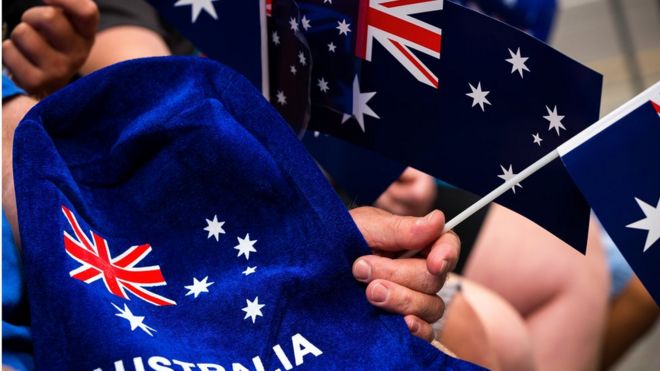
Australia citizenship overhaul hits Senate hurdle

Australian flagsImage copyrightGETTY IMAGES
Image captionAustralia's government will revise a bill on citizenship requirements
An Australian government plan to overhaul its citizenship process has stalled after opposition parties effectively blocked its Senate passage.
The proposed bill would have made it harder to gain citizenship. It included requirements for applicants to have advanced English language skills and four years of permanent residency.
Opponents argued the requirements were too tough on non-English speakers.
PM Malcolm Turnbull's government says it will make amendments to the bill.
Late on Wednesday, a Senate deadline expired after Labor, the Greens and the Nick Xenophon Team signalled they would not support the bill in its current form.
Labor said a demand on applicants to pass university-level language tests had the potential to create an underclass of non-citizens.
Immigration Minister Peter Dutton said the government would negotiate with independents and minor parties on an amended bill, including possible changes to the requirements concerning English.
"We believe very strongly that the proposal we have put forward is moderate, it is sensible," Mr Dutton said on Thursday.
The government has argued the citizenship overhaul will ensure that migrants are better integrated and committed to Australian values.